
 EN
 Italiano
 Français
 Deutsch
 Español
No products in the cart.
Notizie
90s baseball cards worth money: the few that really are
⚡ Quick answer
Most 90s baseball cards worth money are the exception, not the rule: the late 1980s and early 1990s, the so-called “junk wax” era, were printed in such huge numbers that the typical card is worth very little. The ones that do sell for real money are a short list of iconic rookies and errors in top condition. A 1993 SP Derek Jeter graded PSA 10 has sold for over $300,000 (for example $312,000 at Robert Edward Auctions in April 2024), the only PSA 10 of the 1990 Topps Frank Thomas “No Name on Front” error brought $170,400 at Goldin in December 2022, and a 1989 Upper Deck Ken Griffey Jr. in PSA 10 traded at roughly $4,000 to $5,000 in late 2025 and early 2026. The same cards in ordinary condition are worth a small fraction of that.
If you grew up in America in the late 1980s or 1990s, there is a good chance a binder or a shoebox of baseball cards is still sitting in a closet. So, are any of those 90s baseball cards worth money? A few are, sometimes a lot. This guide explains why most cards from that period are common, which ones collectors actually chase, and how to check your own cards without wasting time or grading fees.
Why most 80s and 90s cards are worth little
From the late 1980s to the early 1990s, card makers printed enormous quantities of cards, and many people bought them as an “investment” and stored them carefully. Collectors now call this period the junk wax era. The result is simple: supply is far larger than demand. For most players and most sets, anyone who wants a given card can find dozens of copies, so the price stays low.
That is the honest starting point. A complete set from 1988 or 1990 is usually a nice piece of nostalgia, not a retirement plan. The value is concentrated in a handful of cards, and almost always in copies in near-perfect condition.
The 80s and 90s cards that do sell for real money
These are public, documented sales. Prices are in U.S. dollars and refer to specific copies in a specific grade: a copy in lower condition can be worth a small fraction.
| Card | Why collectors want it | Documented sales |
|---|---|---|
| 1993 SP Derek Jeter #279 | Rookie card of a Hall of Famer; the foil surface chips easily, so gem copies are scarce | PSA 10: $99,100 in May 2018 (then a modern-card record); $312,000 at Robert Edward Auctions, April 2024 |
| 1990 Topps Frank Thomas #414, “No Name on Front” error | Rare printing error: the name plate on the front is missing | The only PSA 10: $170,400 at Goldin, December 2022 |
| 1989 Upper Deck Ken Griffey Jr. #1 | The most iconic card of the era, card #1 of the first Upper Deck set | PSA 10: roughly $4,000 to $5,000+ in late 2025 and early 2026 (eBay and auction sales) |
Notice the pattern: a great player or a famous error, plus the highest grade. Ungraded copies of the Griffey or the Jeter in average shape sell for far less, and the regular 1990 Topps Frank Thomas with his name printed is a common card.
Error cards: when a mistake becomes valuable
Some of the best-known cards of the era are errors. The 1990 Topps Frank Thomas “No Name on Front” happened when part of the print run missed the black ink layer, so the name plate is blank. The 1989 Fleer Billy Ripken #616 is famous because an obscenity was written on the knob of his bat; Fleer corrected it in several ways (scribbles, white-out, a black box), so several variations exist. Ripken himself later admitted he wrote it to mark a batting-practice bat.
Be careful: many “errors” sold online are simply print defects, miscuts or variations that collectors do not value. A real, catalogued error is listed in price guides and recognized by grading companies.
Why condition and grading change everything
- Grade drives price. For cards of this era, the gap between a PSA 10 and a PSA 8 or 9 is huge, because high-grade copies are what is actually scarce.
- Look at the four basics: corners, edges, surface and centering.
- Fragile designs, like the foil on the 1993 SP or the dark borders on some sets, make top grades rarer.
- Grading has a cost. On an ordinary card the fee can be higher than the card’s value.
Where to check real prices
- eBay sold listings: search the exact year, brand, player and card number, then turn on “Sold items”.
- Auction archives: major U.S. houses publish past results with date and grade.
- Grading company population reports: they show how many copies received each grade, which explains why a PSA 10 costs so much more.
Always compare the same card, in the same grade, and note the date: prices for these cards move up and down.
Sort your old cards in 7 steps
- Separate by year and brand (Topps, Fleer, Donruss, Upper Deck, Score, Bowman…).
- Pull the Hall of Famers and stars of the era.
- Look for rookie cards, especially the iconic ones such as the 1989 Upper Deck Griffey and the 1993 SP Jeter.
- Check for known errors and compare them with a price guide.
- Inspect condition under good light: corners, edges, surface, centering.
- Compare with sold listings for the same card and condition.
- Protect the best cards in a sleeve and a rigid holder, and ask an expert before grading or selling.
Mistakes to avoid
- Trusting asking prices: a listing at $5,000 means nothing; only completed sales count.
- Assuming the whole box is valuable: most cards from these years are common.
- Grading everything: send only cards that are both in demand and in excellent shape.
- Mistaking a print defect for a valuable error.
- Storing cards with rubber bands or in damp places: dents and warping destroy the grade.
To show your graded cards dust-free: wood and glass display cases for 1, 8 and 12 graded cards, handmade in Italy, for PSA, CGC, TAG, BGS and SGC slabs.
Frequently asked questions
Are baseball cards from the 90s worth anything?
Most are worth little because they were overproduced. A few iconic rookies and errors, mainly in top grades, sell for hundreds or thousands of dollars, and in rare cases much more.
What is the most valuable 90s baseball card?
Among the cards of the era, the 1993 SP Derek Jeter rookie stands out: PSA 10 copies have sold for over $300,000, such as $312,000 at Robert Edward Auctions in April 2024.
How much is a 1989 Upper Deck Ken Griffey Jr. worth?
It depends on the grade. PSA 10 copies traded at roughly $4,000 to $5,000 in late 2025 and early 2026; lower grades and ungraded copies sell for much less.
What is the Frank Thomas “No Name on Front” card?
A 1990 Topps error where the name plate on the front was left blank. The only copy graded PSA 10 sold for $170,400 at Goldin in December 2022.
What is the Billy Ripken error card?
The 1989 Fleer #616, where an obscenity is visible on the knob of his bat. Fleer corrected it in several ways, so different variations exist.
What does “junk wax era” mean?
It is the collectors’ name for the late 1980s and early 1990s, when cards were mass-produced and most of them lost any scarcity value.
Are 80s baseball cards worth more than 90s cards?
Not as a rule. Both periods include a lot of common cards. What matters is the player, the specific card and the condition.
Should I get my 90s cards graded?
Only cards that are in demand and look close to perfect. For common cards the grading fee usually exceeds the value.
Who can tell me what my cards are worth?
A grading company, a sports card specialist or an auction house. Coins&More does not provide valuations and does not buy cards: for an appraisal, contact a professional expert or an auction house.
Protecting your best cards
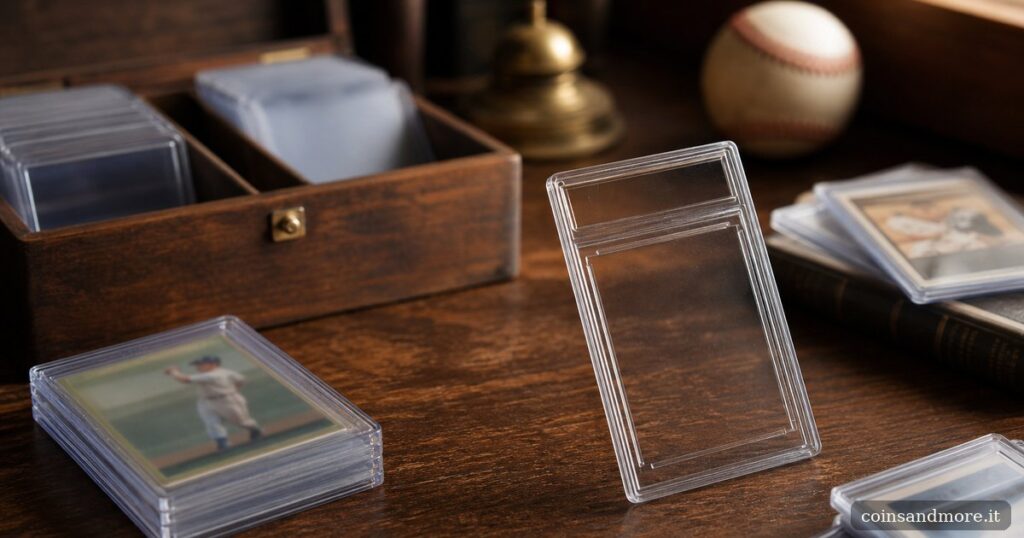
A card worth checking can be kept in a clear rigid card slab until you have it looked at.

Go deeper
Collecting Designer Porcelain: Meissen, Sèvres, Limoges, Capodimonte and Value – Complete Guide
The complete guide on this topic, as an instant digital download. 9,99€
See the guide →Coins&More newsletter
Enjoyed this article? Get the next ones by email
News from our workshop, subscriber-only promotions and tips for your collection. Welcome discount voucher, zero spam.
Join the newsletter →