
 EN
 Italiano
 Français
 Deutsch
 Español
No products in the cart.
Notizie
Most valuable baseball cards: records and how to spot one
⚡ Quick answer
The most valuable baseball cards ever sold are led by a 1952 Topps Mickey Mantle graded SGC 9.5, which brought $12.6 million at Heritage Auctions in August 2022. Right behind come a one-of-one Shohei Ohtani autograph card reported at $11 million in July 2026, the T206 Honus Wagner ($7.25 million, 2022) and the 1914 Baltimore News Babe Ruth ($7.2 million, 2023). What these cards share: a legendary player, true scarcity (often a single copy) and outstanding condition confirmed by a grading company. Most cards found in a closet, especially those printed in huge numbers in the late 1980s and early 1990s, are worth far less.
Every few months a baseball card makes the evening news by selling for millions of dollars, and anyone with an old shoebox of cards starts to wonder. Which are the most valuable baseball cards, and what makes them so special? This guide lists the verified record sales, explains the reasons behind those prices and shows you how to tell whether a card in your own collection deserves a closer look.
The record sales: the most expensive baseball cards
These are public, widely reported sales. Prices are in U.S. dollars and refer to one specific copy in one specific grade: another copy of the same card in different condition can be worth a small fraction.
| Card | Price | When and where |
|---|---|---|
| 1952 Topps Mickey Mantle, SGC 9.5 | $12.6 million | August 2022, Heritage Auctions |
| Shohei Ohtani dual Gold Logoman autograph, one of one | $11 million (reported) | July 2026, private sale |
| T206 Honus Wagner (1909-11) | $7.25 million | August 2022, private sale brokered by Goldin |
| 1914 Baltimore News Babe Ruth | $7.2 million | December 2023, Robert Edwards Auctions |
| 2013 Bowman Chrome Aaron Judge Superfractor autograph, 1/1, BGS 9.5 | $5.2 million | March 2026 |
| 2009 Bowman Chrome Mike Trout Superfractor autograph, 1/1 | $3.936 million | August 2020, Goldin |
| 2024 Topps Chrome Update Paul Skenes MLB Debut Patch autograph, 1/1 | $1.11 million | March 2025, Fanatics Collect |
The Mantle sale is still the record for any baseball card. The Judge card set a record for a modern-era baseball card, and the Skenes card, a patch from his first big-league game, was bought by the retailer Dick’s Sporting Goods.
Why these cards are worth so much
- The player. Legends such as Mantle, Ruth and Wagner, and today’s biggest stars, drive the demand.
- Scarcity. The T206 Wagner was pulled from distribution early and has always been famously hard to find; modern “1/1” cards exist in a single copy by design.
- Condition. A 1952 card in near-perfect shape is extraordinary: most copies were handled, flipped and stored in rubber bands.
- Certification. At these prices the card is always authenticated and graded by companies such as PSA, SGC or Beckett (BGS).
- Story. A rookie card, a debut patch, a record season: the history around the card matters to buyers.
Vintage, junk wax and modern: three different markets
Vintage (before the 1980s)
Older cards were printed in smaller numbers and few survived in good condition. Hall of Famers’ cards and rookie cards from the 1950s and 1960s are the classic targets of serious collectors.
The “junk wax” era (late 1980s to early 1990s)
In those years card makers printed enormous quantities, and many people put cards away as an investment. The result: most cards from that period are common and worth very little. Collectors still chase a few iconic rookies, such as the 1989 Upper Deck Ken Griffey Jr. and the 1993 SP Derek Jeter, but only top-graded copies stand out.
Modern (from the late 1990s)
Today’s market is built on scarcity created on purpose: numbered parallels, autographs, game-used patches and “1/1” cards. The Trout, Judge, Skenes and Ohtani cards in the table are all modern cards of this type.
How to recognize a card worth checking
- Year, brand and set: printed on the back, often in the copyright line.
- Rookie card: the player’s first card in a major set; many modern cards carry an “RC” logo.
- Serial number: a stamp such as 25/50 or 1/1 means a limited print run.
- Autograph or patch: on-card signatures and game-worn material add value when they are certified by the manufacturer.
- Condition: sharp corners, clean edges, no creases, good centering.
Where to check real prices
- eBay sold listings: search the exact card and turn on the “Sold items” filter.
- Auction archives: major U.S. houses such as Heritage and Goldin publish past results.
- Grading company data: PSA and others publish population reports (how many copies received each grade) and price data for graded cards.
Always compare the same card in the same grade, and note the date of each sale: prices move.
Check your cards in 7 steps
- Sort by decade: vintage, late 1980s-early 1990s, modern.
- Pull out the stars: Hall of Famers and today’s top players.
- Look for rookie cards, serial numbers, autographs and patches.
- Check condition under good light: corners, edges, surface, centering.
- Write down year, brand, set and card number.
- Compare with sold listings for the same card and grade.
- Protect the best cards in a sleeve and a rigid holder, then ask an expert before selling.
Mistakes to avoid
- Using asking prices: anyone can list a card for $10,000; only completed sales count.
- Confusing reprints with originals: famous cards like the Mantle have been reprinted many times.
- Cleaning, trimming or pressing cards: graders detect it and the card loses value.
- Assuming every 1990 card is a treasure: production was huge.
- Grading everything: on ordinary cards the fee can exceed the card’s value.
To show your graded cards dust-free: wood and glass display cases for 1, 8 and 12 graded cards, handmade in Italy, for PSA, CGC, TAG, BGS and SGC slabs.
Frequently asked questions
What is the most valuable baseball card ever sold?
A 1952 Topps Mickey Mantle graded SGC 9.5, sold by Heritage Auctions for $12.6 million in August 2022.
How much is a T206 Honus Wagner worth?
It depends heavily on condition. The record is $7.25 million for a copy sold privately in August 2022 through Goldin. Every copy is rare and must be authenticated.
What is the most valuable modern baseball card?
A one-of-one Shohei Ohtani dual Gold Logoman autograph card was reported sold for $11 million in July 2026. In March 2026 the 2013 Bowman Chrome Aaron Judge Superfractor sold for $5.2 million, a record for a modern-era baseball card at the time.
Are baseball cards from the 80s and 90s worth anything?
Most are worth little because they were overproduced. Some iconic rookies, such as the 1989 Upper Deck Ken Griffey Jr. and the 1993 SP Derek Jeter, are sought after in top grades.
How much is the most expensive Babe Ruth card?
A 1914 Baltimore News Babe Ruth, from his minor-league days, sold for $7.2 million at Robert Edwards Auctions in December 2023.
What makes a rookie card valuable?
The player’s career, the set it comes from, scarcity (serial numbers, autographs) and above all condition.
How can I tell if my Mickey Mantle card is real?
Many reprints exist. Check size, card stock and printing, and for any card that could be valuable rely on authentication by a grading company.
Should I get my baseball cards graded?
Only if the card is both sought after and in excellent condition: grading has a cost per card that ordinary cards rarely justify.
Who can tell me what my cards are worth?
A grading company, a sports card specialist or an auction house. Coins&More does not provide valuations and does not buy cards: for an appraisal, contact a professional expert or an auction house.
Protecting your best cards
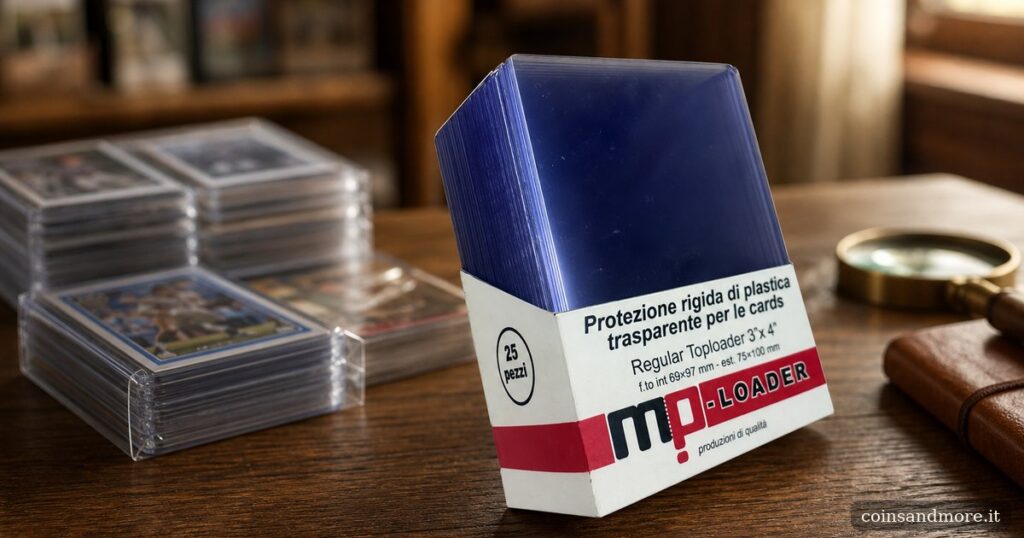
Cards worth checking deserve a sleeve and a rigid toploader until you have them looked at.

Go deeper
Collecting Designer Porcelain: Meissen, Sèvres, Limoges, Capodimonte and Value – Complete Guide
The complete guide on this topic, as an instant digital download. 9,99€
See the guide →Coins&More newsletter
Enjoyed this article? Get the next ones by email
News from our workshop, subscriber-only promotions and tips for your collection. Welcome discount voucher, zero spam.
Join the newsletter →