
 EN
 Italiano
 Français
 Deutsch
 Español
No products in the cart.
Notizie
How to Store Pokemon Cards: Sleeves, Binders, Toploaders
⚡ Quick answer
Here is how to store Pokemon cards without damaging them: every card worth keeping goes into a soft penny sleeve first, then into the right home for its value. Bulk and commons go upright in a box, your set collection goes in a binder with side-loading pockets, rare hits go in a rigid toploader or magnetic holder, and your favorite cards can sit in a wooden, velvet-lined case with a glass lid. Keep everything in a dry living space, out of direct sun: never in the basement, attic or garage, and never with rubber bands.
What’s the best way to store Pokemon cards?
Open a few booster packs and within weeks you have hundreds of cards: bulk commons, energy, duplicates, a handful of holos and, now and then, a hit that is actually worth something. That is when the question of how to store Pokemon cards stops being theoretical. A bent corner, a crease or a scratched holo can wipe out most of a card’s value, no matter how rare it is.
The rule of thumb is simple: the more a card is worth, the more protection it needs. There is no point putting every common in a toploader, and there is no point keeping a chase card loose in a shoebox. Most experienced collectors use tiers:
- Tier 1, bulk and duplicates: upright in a box, sorted by set, with no pressure on them.
- Tier 2, the collection you flip through: in a binder with pocket pages, one card per pocket.
- Tier 3, valuable cards: penny sleeve plus a rigid toploader, or a magnetic one-touch holder.
- Tier 4, your favorites: on display but protected, in a case with a glass lid.
Sleeves, binders, toploaders or a display case: a comparison
Each option does one job well. Use the table to match the card to the storage.
| Option | Best for | Protects against | Downside |
|---|---|---|---|
| Penny sleeve | Any card you want to keep | Scratches, dust, fingerprints | Does not stop bends |
| Binder with pocket pages | Set collections you like to browse | Dust, scratches, clutter | Overfilled binders warp cards |
| Rigid toploader | Hits, cards to ship or grade | Bends, dings, corner wear | Bulky: needs its own storage |
| Magnetic holder or empty slab | Your best cards on display | Bends, dings, dust | One card per holder |
| Wooden case with velvet and glass | A small group of favorites to show off | Dust, knocks, curious hands | Keep it out of direct sunlight |
In practice you layer them: the penny sleeve is almost always the first layer, the toploader or binder pocket comes next, and your top cards end up in a holder or a display case.
Where to store Pokemon cards at home
“Where to store Pokemon cards” matters as much as which sleeve you buy. Cards are printed card stock with a glossy finish, and they react to humidity, heat, light and pressure.
- A dry, lived-in room: bedroom, office or living room, where temperature stays steady.
- Away from windows: direct sun fades colors and heats up plastic sleeves.
- Away from radiators, heating vents and the kitchen: heat and steam make cards curl, especially holos.
- Never the basement, attic or garage: humidity swings are the number one cause of curved, wavy cards and stains.
- On a shelf, not the floor: one spilled drink or a small leak can ruin a whole binder.
If you live somewhere humid, a silica gel packet in the box or cabinet where you keep your binders helps. Check it now and then and replace it when it is saturated.
How to store Pokemon cards in a binder
A binder is the nicest way to keep a collection you actually look at: each set in order, every card by number, the missing ones jumping out at you. But a bad binder can damage cards instead of protecting them.
- Pockets sized for standard cards (about 63 × 88 mm, or 2.5 × 3.5 in), one card per pocket. Two cards back to back in one pocket get pressed and scuffed.
- Acid-free, PVC-free pages that will not stick to the card or yellow it over time.
- Ring binder or fixed pages? Ring binders let you add pages as you grow; fixed-page binders are more compact. In a ring binder, cards near the rings can bend if the binder is overstuffed.
- Do not overfill it: if it will not close flat, the cards inside are curving.
- Store it upright, like a book on a shelf, and do not stack binders on top of each other.
For a small collection, the MasterPhil SuperCard binder (16 × 20 cm) has 14 fixed pages with 4 pockets each. For a growing collection, the MasterPhil CARD COLLECTION 12-pocket binder is sold empty, so you add refill pages as you need them.

Lost track of which binder holds which card? Keep an inventory, either in a spreadsheet or with a dedicated program like the C&M Pokemon + Yu-Gi-Oh! Card Tracker, which helps you tell copies, variants and missing cards apart.
How to store Pokemon cards without a binder
Plenty of collectors skip binders entirely. That works fine if you follow a few rules:
- Card storage boxes: keep cards upright, snug but not squeezed, with dividers between sets. A box that is half empty lets cards slide and bend.
- Toploaders in a box or a toploader binder: for sleeved hits. The MasterPhil TOP BINDER is designed to hold cards already in toploaders or semi-rigid sleeves.
- Semi-rigid card savers: the MasterPhil MP-PROTECTOR 75 × 100 mm sits between a soft sleeve and a toploader, and is the usual choice for cards headed to grading.
- A display case for the few cards you want to see every day (more on that below).
How to store Pokemon cards long term: your valuable cards
Chase cards, full arts, promos and anything you might sell or send for grading need rigid protection. You have three options.
Toploaders. A clear rigid holder open on one short side. The card goes in already sleeved and stays flat, safe from bends and dings. It is the standard for storing and shipping valuable cards. MasterPhil MP-LOADER 3″ × 4″ toploaders come in packs of 25.

Magnetic holders and empty slabs. For the few cards you want to show, a 35PT clear acrylic magnetic holder locks the card between two rigid panels. An empty card slab looks like a graded card case and stands nicely on a shelf. Keep in mind it is just a case, not a grade.
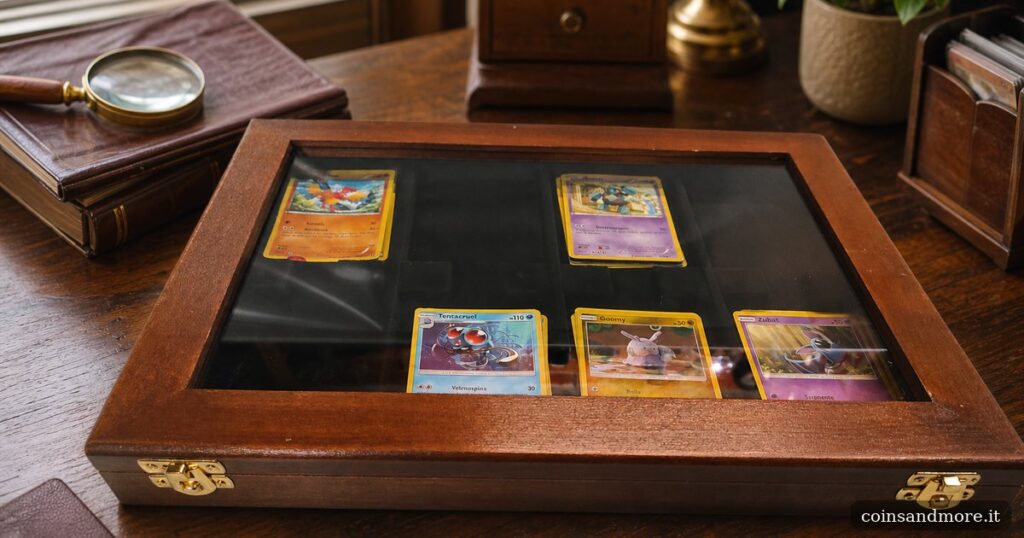
A wooden display case. When you have several favorites, a case keeps them together, visible and safe. In the Coins&More workshop in San Giovanni Teatino, Italy, we make a wooden case for rare Pokemon, Magic and Yu-Gi-Oh cards: solid tulipwood and birch, 8 compartments of 10.7 × 7.5 cm lined in Italian velvet in the color you choose, a glass lid and metal latches. It measures 35.5 × 24 cm, 3.5 cm high, and each piece is numbered with a certificate of authenticity. Every sleeved card gets its own compartment and never touches the others.

Need more compartments or a different size, for example for cards in toploaders? We can build the case to measure: send us the dimensions before you order. We ship to the US and worldwide.
How to store your Pokemon cards in 7 steps
- Wash and dry your hands before handling cards: skin oils leave marks on the glossy surface.
- Split your cards into three groups: bulk and duplicates, binder collection, valuable cards.
- Sort each group by set and card number, printed at the bottom of the card.
- Penny sleeve every card in your collection and every valuable card.
- Add rigid protection to valuable cards: toploader, semi-rigid card saver or magnetic holder.
- Pick the container: upright box for bulk, binder for the collection, toploader binder or display case for the best cards.
- Store it all in a dry room, away from sun and heat, and check your collection a couple of times a year.
Mistakes to avoid
- Rubber bands around a stack: they dent the edges and bend the outer cards. The most common mistake of all.
- Loose cards in a box that slides around: they scratch every time you move it.
- Two cards in one binder pocket: they get pressed and scuffed.
- Overstuffed or stacked binders: the cards inside warp.
- Basement, attic or garage storage: humidity curls card stock and causes stains.
- Displaying cards in the sun, even behind glass: fading is permanent.
- A rare card in a toploader with no sleeve: sliding it in and out can scratch it.
- Tape touching the card when you seal a toploader for shipping.
To show your graded cards dust-free: wood and glass display cases for 1, 8 and 12 graded cards, handmade in Italy, for PSA, CGC, TAG, BGS and SGC slabs.
FAQ
What’s the best way to store Pokemon cards?
It depends on value. Bulk upright in a box, your set collection in a binder, hits in a penny sleeve plus toploader, and your best cards in a rigid holder or a glass-lid case. Always in a dry room out of the sun.
Where should I store my Pokemon cards?
In a lived-in room that stays dry and at a steady temperature, on a shelf rather than the floor. Avoid basements, attics, garages, radiators and sunny windows.
How do you store Pokemon cards long term?
Use PVC-free sleeves, rigid protection for valuable cards, a closed container against dust, and a dry, dark room. Check the collection from time to time so you catch humidity or curling early.
Is a binder or a toploader better?
A binder is great for a collection you browse; a toploader protects better against bends and is the better choice for rare cards. Many collectors use both, or a binder made for toploaders.
How do I store Pokemon cards without a binder?
In a rigid storage box, upright and sorted by set with dividers, or in toploaders inside a box or toploader binder. Your favorite cards can go in a glass-lid display case.
Do Pokemon cards get damaged in a binder?
Not if the pockets are the right size, there is one card per pocket and the binder is not overfilled. Cards near the rings can bend in an overstuffed ring binder.
How do I display Pokemon cards without damaging them?
In a magnetic holder, an empty slab or a case with a glass lid, away from direct sunlight. Our wooden velvet-lined case has 8 compartments of 10.7 × 7.5 cm.
Can curled Pokemon cards be flattened?
Sometimes they flatten on their own in a dry room under light, even pressure, but there is no guarantee. Prevention, by keeping them away from humidity and heat, works much better.
Do you ship card display cases to the US?
Yes, we ship worldwide with tracked courier service. Check the product page for times and costs to your country, or write to us before ordering.
A safe home for the cards that matter
A rare Pokemon card is a small piece of card stock: one rubber band, one humid summer or one sunny shelf can ruin it. In our trading card accessories category you will find binders, toploaders, semi-rigid card savers and holders for every tier of your collection, along with our wooden velvet-lined case, made, signed and numbered in the Coins&More workshop in San Giovanni Teatino.
→ Browse all trading card storage
Read also: Pokemon card tracker: spreadsheet or software?
Coins&More newsletter
Enjoyed this article? Get the next ones by email
News from our workshop, subscriber-only promotions and tips for your collection. Welcome discount voucher, zero spam.
Join the newsletter →