
 EN
 Italiano
 Français
 Deutsch
 Español
No products in the cart.
Notizie
How to Wear a Pocket Watch (and How to Store It)
⚡ Quick answer
How to wear a pocket watch: the classic way is in a vest pocket, with an Albert chain secured to a buttonhole by its T-bar. Without a vest, slip it into the small watch pocket of your jeans or trousers and clip a short chain to a belt loop. At home, store it dial up in its own padded compartment (about 70×60 mm fits most men’s pocket watches), away from humidity, magnets and temperature swings, with the chain stored separately.
By Furio Troiano, founder of Coins&More (since 2017). Updated November 2026.
How to wear a pocket watch with a vest
If you are searching for how to wear a pocket watch, chances are you just inherited one, picked one up at an antique mall, or got hooked after watching a few episodes of Peaky Blinders. The rules are simpler than they look. They come from a time when the pocket watch was a working tool, pulled out dozens of times a day, so everything is designed to keep it safe and within reach.
The traditional way is with a vest (waistcoat). The watch goes into one of the lower vest pockets, usually the one opposite your dominant hand so you can draw it easily. The chain runs from the watch to a buttonhole, where the T-bar slides through and turns sideways so it cannot slip out. The chain should hang in a relaxed curve: too short and the watch pops out every time you sit down, too long and it swings and knocks against things.
A double Albert chain has the T-bar in a central buttonhole, the watch in one pocket and a small item in the opposite pocket: a fob, a winding key, a seal or a cigar cutter. It is the most dramatic look, the one you see in period dramas set in the early 1900s.
Two small details make a big difference. Put the watch in the pocket with the dial facing your body, so the crystal is protected from bumps against desks and door frames. And never pull the watch out by the chain: take hold of the case with your fingers. The chain is a safety line, not a handle.
How to wear a pocket watch chain: the options
The chain decides how you wear the watch. Antique gold and silver chains are collectibles in their own right, often hallmarked; modern stainless steel chains are tougher and perfectly fine for everyday wear.
| Chain type | Where it attaches | Best for |
|---|---|---|
| Single Albert with T-bar | Vest buttonhole | Three-piece suits, formal events |
| Double Albert | Central buttonhole, two pockets | Vintage looks, weddings, themed events |
| Short chain with clip or belt loop slide | Belt loop | Jeans, chinos, casual wear |
| Leather or ribbon fob | Hangs from the trouser watch pocket | Suits without a vest, understated style |
| Long necklace chain | Around the neck | Ladies’ and small watches |
As a rule, match the chain to the case: gold-tone chain with a gold or gold-filled case, silver or steel with silver and white-metal cases. An antique silver chain tarnishes just like the case, so store it with the same care, but not on top of the watch.
How to wear a pocket watch with jeans or without a vest
Few people wear a vest every day, but a pocket watch works well without one. These are the most common ways.
With jeans. That tiny pocket above the right front pocket of your jeans was originally a watch pocket. Drop the watch in, and connect a short chain to a belt loop with a clip or a belt loop slide. It is the easiest way to wear a pocket watch casually, every day.
With dress pants. Some tailored trousers still have a small watch pocket at the waistband. Otherwise use the front pocket with a chain to the belt loop, or a leather fob left visible.
With a blazer or suit jacket. Keep the watch in the inside breast pocket with the chain fixed to the lapel buttonhole or an inside button. It is less handy to check, but very discreet with a suit worn without a vest.
For women, the classic choices are a necklace watch or a brooch-style pin with a smaller, lighter watch. Whatever you choose, never keep the watch in the same pocket as your keys or phone. Keys scratch the case and crystal, while phones and the magnetic clasps on bags and wallets can magnetize the hairspring, and a magnetized watch suddenly starts running fast.
Pocket watch storage: where it should live
This is where the watch’s long-term health is decided. A pocket watch spends far more time resting than being worn, and most damage happens at home: a cracked crystal at the bottom of a drawer, a tarnished silver case, a dented hunter lid, a chain that scratched the caseback.
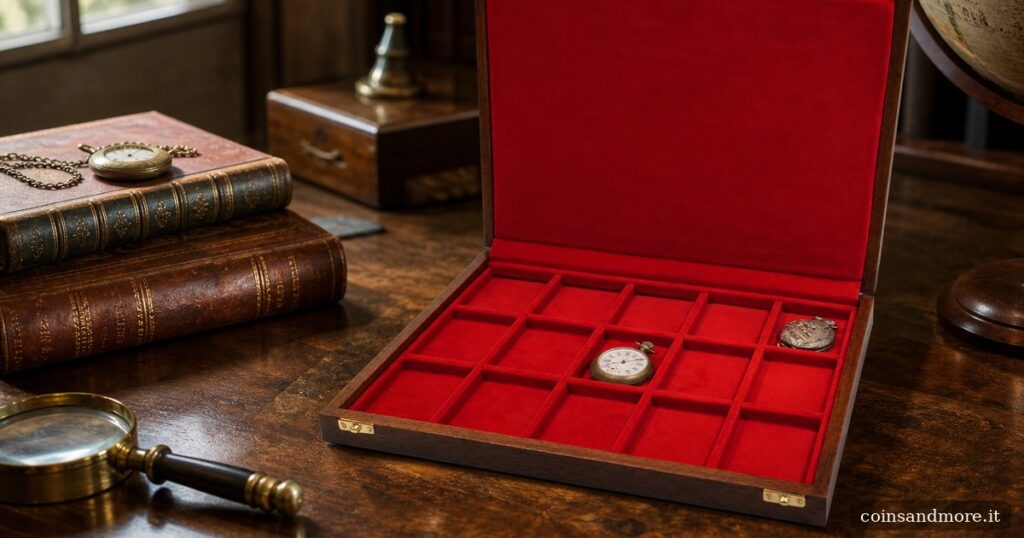
The basic rule: one watch, one compartment. A padded velvet compartment holds the watch still, keeps it from touching the others and protects it from dust. Men’s pocket watches usually measure roughly 45 to 55 mm across, so a 70×60 mm compartment leaves room for the bow and crown; for larger watches, or to keep a length of chain with the watch, a 75×75 mm compartment is handy.
Lay the watch dial up or flat, never on its edge where it can slide. If it is a hunter case, keep the lid closed: it protects the crystal. Coil chains loosely in the next compartment, not over the watch, because their weight marks the case over time. And skip the basement, attic or bathroom: humidity and temperature swings are what hurt movements and dials most.

How to store a pocket watch in 7 steps
- Wipe it before you put it away. A dry microfiber cloth removes fingerprints and sweat that stain metal over time. No liquids near the crown.
- Decide whether to keep it running. For a few days, do nothing. For long storage, many watchmakers suggest winding and running it now and then, say once a month, so the oils stay spread.
- Wind gently. Turn the crown until you feel resistance, then stop. Forcing it is the fastest way to break a mainspring. On key-wind watches use the correct key, never pliers.
- One compartment per watch. Each watch in its own padded slot, dial up or lid closed.
- Chains separately. Coil the chain in a nearby compartment or a soft pouch, never across the crystal.
- Pick the right spot. A cabinet in a lived-in room, away from windows, radiators, the bathroom and the kitchen.
- Check in regularly. Every few months open the box, look for tarnish or condensation under the crystal, and run the watches you care about most.
Then there is servicing: a mechanical movement needs periodic cleaning and oiling. The right interval depends on the watch and how much you use it, and a trusted watchmaker can tell you. A watch that gains or loses a lot, or stops on its own, should be seen sooner.
Storage box, display case or tray?
There is no single best pocket watch storage case: it depends on how many watches you own, whether you want to see them, and how often you wear them. Here are the options we make in the Coins&More workshop in San Giovanni Teatino, Italy, all in wood and velvet.
| Option | Capacity | Best for |
|---|---|---|
| Closed wood and velvet storage box | 15 compartments, 70×60 mm | Protecting a collection from light and dust |
| Display case with glass lid | 15 compartments, 70×60 mm | Seeing the collection without opening it |
| Velvet tray | 15 padded compartments | Drawers, cabinets, display furniture |
| Single display box | 1 compartment, 75×75 mm | A family heirloom or a gift |
The pocket watch storage box with a wooden lid is the most protective choice: in the dark, the velvet does not fade and silver cases tarnish more slowly. If you want to enjoy the collection every time you walk by, the 15-compartment pocket watch display case with glass lid works like a small showcase; just keep it out of direct sunlight.

The velvet pocket watch tray is for collectors who already own a cabinet: it fits in a drawer and turns any shelf into tidy watch storage. For one important watch, there is the single-compartment display box. Every piece is numbered and comes with a certificate of authenticity, and we ship to the United States and worldwide.

Mistakes to avoid
- Pulling the watch out by the chain. It strains the bow and crown; take hold of the case.
- Sharing a pocket with keys or a phone. Scratches for sure, and a risk of magnetization.
- Overwinding. When the crown resists, the watch is fully wound.
- Tossing it loose in a drawer. Watches knock together, crystals crack, lids dent.
- Storing it in the basement, garage, attic or bathroom. Humidity and temperature swings damage the movement and dial.
- Polishing silver with harsh pastes. On an antique watch the wrong cleaning can wipe out details and hallmarks; when in doubt, ask a watchmaker.
- Opening the caseback yourself. Dust and fingerprints on the movement do more harm than years in a drawer.
FAQ
How do you wear a pocket watch?
Traditionally in a vest pocket, with an Albert chain secured to a buttonhole by its T-bar. Without a vest, use the small watch pocket of your jeans or trousers with a short chain clipped to a belt loop.
How do you wear a pocket watch with jeans?
Put it in the small watch pocket above the right front pocket and attach a short chain to the nearest belt loop with a clip or a belt loop slide.
Can you wear a pocket watch without a vest?
Yes. Use the jeans watch pocket, a trouser pocket with a fob, or the inside pocket of a blazer with the chain fixed to the lapel buttonhole.
Where do you wear a pocket watch on a suit?
With a three-piece suit, in a lower vest pocket with the chain to a buttonhole. With a two-piece suit, in the trouser watch pocket with a fob or in the inside jacket pocket.
How do you wear a double Albert chain?
The T-bar goes through a central vest buttonhole, the watch sits in one lower pocket and a fob or small item sits in the opposite pocket, with the chain hanging in two even curves.
What is the best way to store a pocket watch?
In its own padded compartment, dial up, inside a closed box kept in a dry room away from magnets and temperature swings, with the chain stored separately.
What size compartment does a pocket watch need?
About 70×60 mm fits most men’s pocket watches. For larger watches, or to keep some chain with the watch, a 75×75 mm compartment is more comfortable. Always measure diameter and thickness including the crown.
Should I keep a stored pocket watch wound?
It is not required, but many watchmakers suggest running it now and then, for example once a month, to keep the oils spread. Always stop winding at the first resistance.
How do I keep a silver pocket watch from tarnishing?
Store it in a closed box away from humid air and rubber, and wipe it only with a soft dry cloth. For existing tarnish on an antique, ask a watchmaker.
Find the right home for your pocket watches
A pocket watch is built to outlast its owner, as long as it is treated well both on the move and at rest. Our boxes and trays are made in the Coins&More workshop in San Giovanni Teatino, Italy, in wood and velvet, with compartments sized for pocket watches. See every model in the pocket watch boxes category.
→ Browse pocket watch storage boxes
Read also: How to store an automatic watch (and all the others).
Coins&More newsletter
Enjoyed this article? Get the next ones by email
News from our workshop, subscriber-only promotions and tips for your collection. Welcome discount voucher, zero spam.
Join the newsletter →