
 EN
 Italiano
 Français
 Deutsch
 Español
No products in the cart.
Notizie
Coin Display Case or Album: When to Switch to Wood
⚡ Quick answer
A coin display case in wood and velvet is the right upgrade once you own coins that deserve more than a plastic pocket: Brilliant Uncirculated or proof coins, silver and gold pieces, coins already in capsules, or a selection you want to show or give as a gift. A coin album with clear pages is still the best way to store circulated coins, sets in progress and duplicates: it costs pennies per slot and flips like a book. For most collectors, the best way to store coins is both: album for the collection, wood for the best pieces.
By Furio Troiano, founder of Coins&More (since 2017). Updated November 2026.
Coin album vs. coin display case: two different jobs
Most collectors follow the same path. A few coins set aside in a jar, then a binder with clear pocket pages, then a second binder. Sooner or later the question comes up: what is the best way to store coins for collecting? Should you keep adding albums, or is it time for a coin display case made of wood?
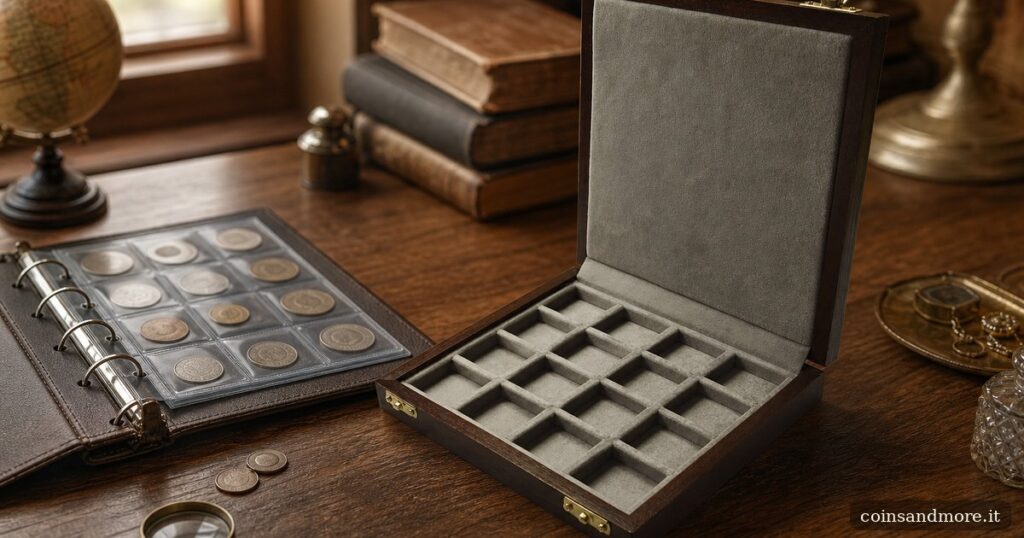
The honest answer is that neither is “better” in general. They are built for different jobs. An album is a collecting tool: it holds a lot of coins in little space, shows them all at once and tells you at a glance what is missing from a set. A wooden coin case with velvet slots is a protection and display tool: it holds fewer coins, but each one gets its own padded slot, away from bumps, dust and light.
In our workshop in Italy we often see collectors arrive with a full binder and a dozen “important” coins tucked into the same pages as pocket change. That is exactly when wood makes sense: not to replace the album, but to give the coins that deserve it a separate home.
To decide where each coin belongs, ask yourself three questions:
- How much is it worth, in money or to you? The higher the value, the more protection matters.
- What condition is it in? A circulated coin can take a lot; a proof or BU coin loses value from a single hairline scratch.
- What do you want to do with it? Flip through it and complete a set, or show it, give it, pass it down?
Album or wooden coin case: side-by-side comparison
Here is a direct comparison between a coin album with pocket pages and a wood-and-velvet coin case. Indicative prices are for models in our shop.
| Criteria | Coin album / binder | Wooden coin display case |
|---|---|---|
| Cost per slot | Very low: the MasterPhil Money album with 96 pockets is about €26 (under 30 cents per slot) | Higher: the 16-slot 40×40 mm case is about €68 (roughly €4 per slot) |
| Capacity | High: dozens to hundreds of coins, add pages as you go | Limited: from 1 to about 20 slots per case |
| Protection from bumps and pressure | Low: pages bend, heavy coins pull on the plastic | High: solid wood walls and a padded slot |
| Dust and light | Good if the album sits in a slipcase | Excellent with the lid closed |
| Coins in capsules | Difficult: capsules often don’t fit the pockets | Ideal: you pick the slot size to fit the capsule |
| Browsing | Very fast, like a book | Open the lid and see everything at once |
| Display and gifting | Practical, not very elegant | Made to be shown and given |
| Best for | Circulated coins, sets in progress, duplicates | BU, proof, silver, gold, ancient coins |
In short: the album wins on capacity and cost, the case wins on protection and presentation. The MasterPhil pages we sell, such as the UNI pages with 35 pockets 35×35 mm or the Congresso pages with 56 pockets 30×30 mm, are great for keeping a collection organized. Our wooden cases, made in the Coins&More workshop in San Giovanni Teatino, Italy, in wood and Italian velvet, are the home for your best pieces.

Are coin albums bad for coins?
It is one of the most searched questions in the hobby. The short answer: a good album won’t hurt your coins, a bad one will. Problems come from three things:
- Soft PVC plastic: over the years it releases plasticizers that leave a greenish, sticky film on coins. If you buy pages or flips, always check they are PVC-free.
- Friction: every time you slide a coin in or out of a pocket, its surface rubs against the plastic. On a circulated coin you won’t notice; on a proof you will.
- Weight and pressure: large, heavy coins stretch the pages, and a closed binder presses the pages together, so high-relief coins can get marked.
For circulated coins, state quarters, euro sets or duplicates, an album is still an excellent choice. For coins where every detail of the surface counts, a padded slot where the coin (ideally in a capsule) is never slid against anything is safer.
When to switch to a wooden coin display case: 6 signs
There is no magic number of coins after which you “have to” switch to wood. There are, however, clear signs. If you recognize at least two, it’s time.
- You own BU or proof coins. They are the most sensitive to scratches and fingerprints and deserve a capsule and a slot of their own.
- You own silver or gold. Silver tones and changes color; gold is soft and scratches easily. A gold sovereign (22.05 mm) should not share a pocket page with pocket change.
- Your coins are already in capsules. Hard capsules often don’t fit album pockets, or they stretch them. In a case, you choose the slot by the outside diameter of the capsule.
- You want to display your collection. You flip through an album; you open a case on the table and look at it. It’s a different experience, for you and for your guests.
- It’s a gift or you are thinking long term. For a graduation, a retirement or a collection you plan to pass down, wood makes the gesture feel important. Our cases are numbered and come with a certificate of authenticity.
- Your album has become a mixed bag. When the same pages hold coins worth a few dollars and coins worth hundreds, it’s time to split: collection on one side, selection on the other.

How to move coins from an album to a case in 6 steps
Take your time and move one coin at a time. This is the method we recommend:
- Select. Go through the album and pull out only your best coins: the valuable ones, the high-grade ones, the ones you care about most. Everything else stays in the album.
- Measure. Write down the diameter of each coin and, if it is in a capsule, the outside diameter of the capsule. For reference, a 2 euro coin is 25.75 mm.
- Pick the slot size. Bare coins up to about 28 mm fit 30×30 mm slots; coins in capsules or mid-size coins fit 40×40 mm; medals, large coins and coins in thick capsules fit 50×50 mm. See the table below.
- Prepare your workspace. A soft cloth, clean and dry hands, ideally cotton or nitrile gloves for BU and proof coins.
- Hold each coin by the edge. Never touch the faces and never clean a coin before moving it: any cleaning leaves marks an expert will spot immediately.
- Catalog and store. Note which coin sits in which slot and keep the case in a dry room, ideally between 40% and 50% relative humidity.
If you want a complete method to organize the whole collection, read our guide on how to organize a coin collection.
What slot size do you need?
Slot size is where most doubts come from. The rule is simple: the slot should be a few millimeters larger than the coin (or the capsule), so you can lift it out and put it back without forcing it.
| Slot | What fits well | Examples from our catalog |
|---|---|---|
| 30×30 mm | Bare coins up to about 28 mm: euro coins, sovereigns, many ancient coins | 20-slot case, 2-slot case |
| 40×40 mm | Coins in thin capsules, mid-size coins, some 1 oz silver coins without capsule | 16-slot 40×40 mm case |
| 50×50 mm | Medals, large coins, coins in thick capsules | case with custom compartments and velvet, single 50×50 mm slot case |
When in doubt between two sizes, go for the larger one: a coin with a little room can be centered, a slot that is too tight never gets bigger. For more detail, see our guide on how to choose a coin case.

Mistakes to avoid when you upgrade your coin storage
- Throwing away the album. No need: keep it for the collection and the duplicates. The case is for your selection.
- Cleaning coins before moving them. It’s the mistake that destroys the most value. Store a coin as it is.
- Choosing slots that are too tight. If you have to push the coin in, you are scratching it.
- Storing the case in the basement, attic or garage. Humidity and temperature swings are bad for coins and wood. A lived-in room, away from radiators and windows, is the best place to store coins at home. More in our article on humidity and collections.
- Filling the case “because there’s room.” A case is a showcase: put your best coins in it, not leftovers.
- Skipping the catalog. A numbered slot and a record with photo and provenance are worth a lot, especially when one day you want a professional to appraise the collection.
- Leaving silver exposed for months. Even in a case, uncapsuled silver tends to tone: use capsules for delicate pieces and keep the lid closed.
When your cases start to multiply, the next step is a coin cabinet with drawers. We cover it in handmade or mass-produced coin cabinet: how to choose.
Frequently asked questions
What is the best coin display case for a collection?
One with a solid wood frame, padded velvet slots sized a few millimeters larger than your coins or capsules, and a lid that closes well against dust and light. Choose the slot size before the model.
What is the best way to store coins for collecting?
Combine two systems: an album with PVC-free pages for circulated coins and sets in progress, and a wooden case for BU, proof, silver, gold and ancient coins, ideally in capsules.
Are coin albums bad for coins?
Good ones aren’t. The risks come from soft PVC pages that leave residue over time, friction when sliding coins in and out, and pressure from the pages on thicker coins.
What is the best way to store coins long term?
In capsules, inside a closed wooden case, in a room with stable temperature and 40-50% humidity. Never clean coins and handle them only by the edge.
What is the best way to store coins at home?
In a lived-in room, away from windows, radiators, kitchens and bathrooms. Avoid basements, attics and garages, where humidity and temperature swing the most.
How do you store silver coins so they don’t tarnish?
Keep them in capsules and in a closed case, away from humidity, rubber bands and materials that release sulfur. Some toning is natural: an even patina should not be removed.
Can I store coins in capsules inside a wooden case?
Yes, it’s the safest combination. Measure the outside diameter of the capsule and choose a slot a few millimeters larger.
Is a wooden coin case worth it for a few coins?
If those few coins are valuable, high grade or a gift, yes: a single-slot or 2-slot case protects them and presents them well. For many inexpensive coins, an album is more practical.
Do you ship coin display cases to the US?
Yes, we ship worldwide, including the United States. Import duties for the US are paid by the customer on delivery.
Find the right storage for your coins
If you are still building your collection, browse our MasterPhil coin albums and binders: pages and albums for every coin size. If you already have pieces that deserve better, our wood and velvet coin cases are made in the Coins&More workshop in San Giovanni Teatino, Italy, signed and numbered, with 30, 40 or 50 mm slots. We ship worldwide.
→ Browse our wooden coin display cases
Read also: How to store 2 euro coins without damaging them.
Coins&More newsletter
Enjoyed this article? Get the next ones by email
News from our workshop, subscriber-only promotions and tips for your collection. Welcome discount voucher, zero spam.
Join the newsletter →