
 EN
 Italiano
 Français
 Deutsch
 Español
No products in the cart.
Notizie
Fountain Pen Display Case: Upright, Tray or Cabinet?
⚡ Quick answer
The right fountain pen display case depends on how many pens you own and what you want to do with them. To show off up to about 20 pens, pick a slanted wood case with a glass lid (16-18 slots). For the pens you use every day, a velvet pen tray with 11 or 17 slots is enough. Past 40 pens, a pen cabinet with drawers (39, 91 or 143 slots) keeps everything flat, organized and out of the light. Upright cups are fine only for inked pens in use, nib up.
By Furio Troiano, founder of Coins&More (since 2017). Updated November 2026.
Upright, tray or cabinet: the short answer
Most people start looking for a fountain pen display case the same way: the pens have outgrown the desk drawer, you want to see them, find them fast and keep them from getting scratched. There are four common options, and each one fits a different stage of a collection.
Before you look at models, answer three questions: how many pens you own (and how many you’ll own in two years), how many you actually ink and use, and where the case will live: a home office, a living room shelf or a store counter.
| Option | Typical capacity | Best for | Downside |
|---|---|---|---|
| Upright pen cup or stand | 3-10 pens | Inked pens on your desk | No dust protection, pens rub together |
| Slanted case with glass | 16-54 pens | Displaying a selection at home or in a store | Must stay out of direct sunlight |
| Velvet pen tray | 11-17 pens | Pens in rotation, desk drawers | Open: collects dust if left out |
| Cabinet with drawers | 39-143 pens | Large collections, valuable pens | Bigger footprint, higher investment |
Many collectors end up combining two: a cabinet or a display case for the collection, plus a tray for the three or four pens currently inked.
What makes the best fountain pen display case
Whatever the style, a good case does four things. It keeps every pen in its own slot, so clips and metal trims don’t scratch the pen next to it. It keeps pens lying flat, which is the safest position for storage. It keeps out dust and fingerprints. And it keeps out direct light, which fades colored resins and celluloid and turns hard rubber brownish.
That’s why upright cups are great for daily writers but weak for a collection. If you do store inked pens upright, keep them nib up: nib down, ink drains into the feed and the cap, and you’ll get inky fingers the next time you uncap. We cover this in detail in our article on whether to store fountain pens upright or flat.
Wood fountain pen display case with glass
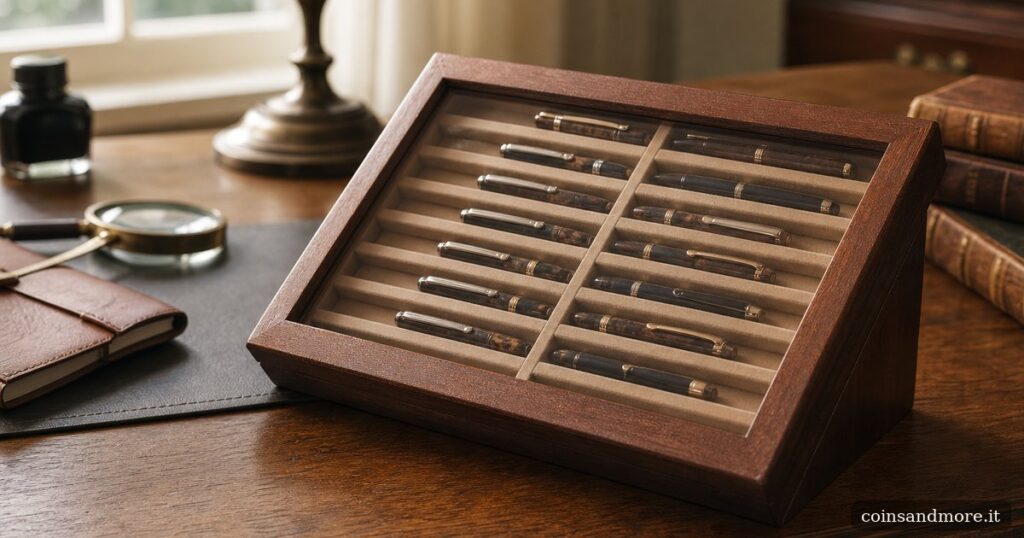
If you want to see your pens, a wood case with a glass lid is the natural choice. A slanted, lectern-style case has a real advantage: the pens lie flat, each in its own velvet channel, but the whole tray faces you, so you can read brands, colors and trims without opening anything. The glass keeps dust and fingers away.
That’s how our pen cases are built. The 16-pen display case and the 18-pen display case (about 13.8 x 10.6 in, 35 x 27 cm) have a wood frame, 3 mm (1/8 in) glass and Italian velvet slots. For bigger collections there’s the wood and velvet showcase for up to 36 pens.

What to check in a glass pen case:
- Slot length: measure your longest pen with the cap posted. Oversize pens need longer channels.
- Glass or acrylic: acrylic is lighter but scratches more easily. Glass stays clear and wipes clean.
- Velvet: soft, lint-free lining. Light velvet makes dark pens pop; dark velvet flatters sterling silver, gold trims and light resins.
- Closure: with kids at home or in a public office, choose a case that closes securely.
Collectors often ask for an antique fountain pen display case. Vintage pens need the same thing modern ones do, only more so: flat storage, no direct sun, stable room temperature. Very old celluloid prefers a case that gets opened and aired now and then rather than an airtight box.
Pen trays for your desk and drawers
A tray is the simplest solution and often the first one people buy. It keeps pens flat and apart, sits on your desk while you write and slides into a drawer when you’re done. It’s also the best way to manage your “rotation”, the pens you currently have inked.
Our pen trays come with 11 or 17 slots. The 17-slot velvet display tray has a padded moiré satin base and comes in 18 velvet colors; the walnut-finish birch tray with 11 individual slots is made for the desktop.
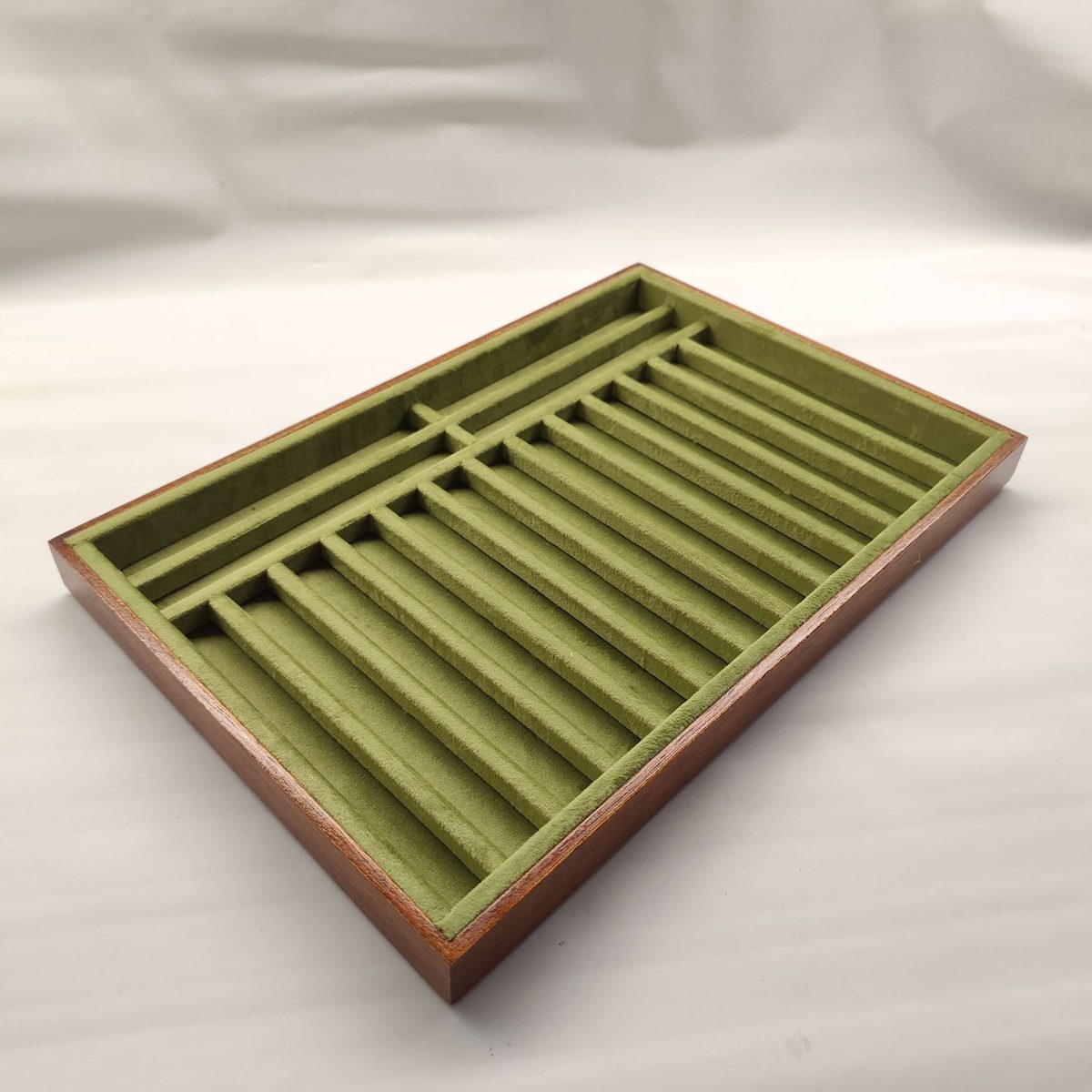
A collector’s trick: use trays of the same size in different velvet colors to split the collection by brand, by era or by type (fountain, ballpoint, rollerball). Stacked in a drawer, they become a tidy archive. The only catch is that a tray is open, so don’t leave it on a sunny desk for months.
Fountain pen storage box with drawers
Once you’re past 40 or 50 pens, trays multiply and the collection spreads around the house. That’s when a pen cabinet with drawers makes sense: one piece of furniture, every drawer lined in velvet with individual slots, pens flat and in the dark.
In our workshop we make a 3-drawer cabinet for 39 pens (with 4 mm glass), a 7-drawer cabinet for 91 pens and an 11-drawer model for 143 pens. If you want lighting too, there’s the walnut pen cabinet with glass and LED (about 16.1 x 12.2 x 7.9 in, 41 x 31 x 20 cm, 18 pens per drawer).

A cabinet does two things a glass case can’t: it blocks light and it keeps order. Give each drawer a brand or a decade and you’ll always know where a pen is. For a large collection, pair it with a catalog: our C&M pen collection software helps you catalog fountain pens on PC and Mac.
Shop owners looking for a counter case for high-end pens can look at our 54-pen display case in solid wood and Italian velvet, also a good fit for trade show booths.
How to choose a pen display case in 6 steps
- Count your pens and add a margin. Collections grow. If you own 25 pens today, shop for 35-40 slots.
- Separate daily writers from the collection. Inked pens go in a tray within reach; the rest go in a glass case or a cabinet.
- Measure your longest pen. Capped and posted, then compare it with the slot length listed on the product page.
- Decide: show or protect? A glass lid to display them, drawers to keep them in the dark. Vintage celluloid and hard rubber pens love the dark.
- Pick the spot before the model. A lived-in room, away from windows, heating vents and humidity. Skip the basement, the attic and the garage.
- Choose wood and velvet color. Light velvet for dark pens, dark velvet for silver, gold and light resins, and a wood tone that matches your desk or shelf.
Wood, acrylic or metal? Wood with velvet is the classic choice: it doesn’t scratch, it absorbs small knocks and it looks right in a study. Acrylic alone is light but scuffs and attracts dust through static; bare metal can mark the barrels. For a collection, wood and velvet remain the safest bet.
Mistakes to avoid
- Inked pens stored nib down in an upright stand: ink pools in the cap and stains your fingers.
- Several pens in one compartment: clips scratch neighboring barrels. One pen, one slot.
- A display case facing a window: direct sunlight fades resins and celluloid for good.
- Buying “just enough” slots: a case that’s full on day one is already too small.
- Slots that are too short: a pen that sticks out won’t sit flat under the glass.
- Vintage pens sealed airtight: old celluloid prefers a case that gets opened now and then.
- Spraying glass cleaner inside the case: spray the cloth, never near the velvet and the pens.
FAQ
What is the best fountain pen display case?
It depends on the size of your collection: a velvet tray for 11-17 daily writers, a slanted glass case to display 16-36 pens, a cabinet with drawers for 40 pens and up. In every case, each pen should have its own slot and lie flat.
Is a wood fountain pen display case better than acrylic?
Wood lined with velvet protects better: it doesn’t scratch, cushions knocks and doesn’t attract dust. Acrylic is light but scuffs easily. For the clear lid, glass stays clearer over time.
Should fountain pens be stored upright or flat?
Flat, especially if they’re part of a collection and empty. Upright is fine only for inked pens in daily use, and always nib up.
What’s the best fountain pen storage case with drawers?
Look for velvet-lined drawers with individual slots, a size that leaves room to grow and, if you want to show your favorites, a glass top. Our cabinets hold 39, 91 or 143 pens.
How do I display an antique fountain pen collection?
Empty, flat, away from heat and direct light, in a case that isn’t airtight and gets opened now and then. Keep any celluloid pen showing cracks or a sour smell away from the others.
How do I travel with fountain pens?
In a pen case that holds them still, nib up. On a plane, many collectors fly with pens either completely full or completely empty and uncap them only after landing, with a tissue at hand.
Where should I put a pen display case at home?
In a lived-in room, on a wall or shelf the sun doesn’t reach, away from radiators, vents and damp areas like bathrooms, basements and garages.
How do I clean a wood and velvet pen case?
Velvet with a soft brush or a dry cloth, wood with a barely damp cloth followed by a dry one. For the glass, spray cleaner on the cloth, not on the glass, so the velvet stays dry.
Do you ship pen display cases to the US?
Yes, we ship worldwide, including the United States. Check the product page for shipping options, or write to us before you order.
A proper place for every pen in your collection
Our pen display cases, trays and cabinets are made in the Coins&More workshop in San Giovanni Teatino, Italy, in wood and velvet, with slots that keep every pen flat and apart from the others. Each piece is signed and numbered. Browse glass cases in pen display cases, desk solutions in pen trays and storage for large collections in pen cabinets.
→ See our fountain pen display cases
Read next: Should fountain pens be stored upright or flat?
Coins&More newsletter
Enjoyed this article? Get the next ones by email
News from our workshop, subscriber-only promotions and tips for your collection. Welcome discount voucher, zero spam.
Join the newsletter →